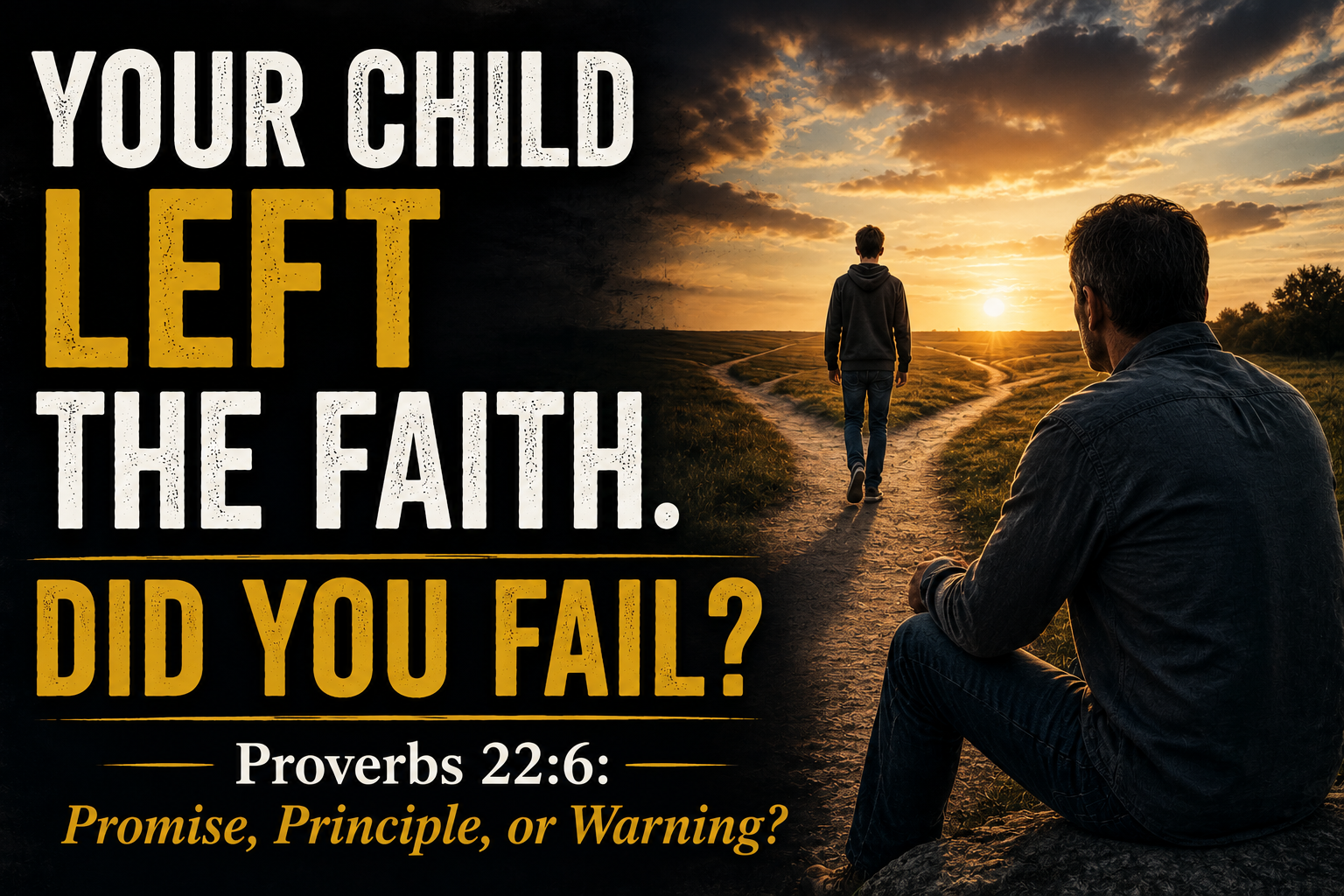
Your Child Left the Faith. Did You Fail?
Proverbs 22:6 says:
“Train up a child in the way he should go; even when he is old, he will not depart from it.” (ESV)
“Train up a child in the way he should go; and when he is old, he will not depart from it.” (KJV)
“Train up a child according to his way, even when he is old, he will not depart from it.” (LSB)
“Train up a child according to the tenor of his way, and when he is old, he will not depart from it.” (Darby)
This verse was in our congregation’s Bible Reading this week, and this seemed a good time to address some common ideas surrounding it.
Sadly, I must confess that teachers, church leaders, and preachers have traditionally used this verse in a way that guilt parents. The message typically communicates this idea: “Faithful parents and correct training will result in faithful adult children.” Parents who have unfaithful adult children hear, “Your adult child walked away from God; therefore, you must not have raised him/her correctly.” This can hurt parents very deeply. Is this what the wise man is teaching? Is this what God is teaching? Faithful parents with good practices always produce good children?
I understand that the Hebrew phraseology might be slightly ambiguous. The ambiguity lies in what the phrase “according to his way” means. What exactly is “his way?” Here are some possibilities interpreters offer. Some are stronger than others:
- Train a child according to his individual bent. His way could mean the child’s temperament, capacities, developmental level, particular disposition, or even his interests and talents. If so, Prov 22:6 says, “Don’t raise every child identically; train them according to them.” The lessons have lasting impact because they are individualized.
- Train a child according to what is appropriate for their age or development level. Don’t expect a younger child to learn the same as an older child.
- Initiate her into the way she ought to go. Teach her the proper path. Instruct her in wisdom and discernment, not the way of folly or foolishness.
- Let a child have his own way long enough, and you’ll produce an adult who expects to always have his own way. This makes the proverb a warning from a negative. Consider a similar approach in Proverbs 22:15, “Folly is bound up in the heart of a child . . .” and Proverbs 29:15, “. . . a child left to himself brings shame to his mother.”
- Early habits become deeply ingrained. This gives the proverb the tone of a generalization. Good habits or bad habits become deeply ingrained. Which will we instill in our children?
No matter how we understand the phrase, this is still a proverb, not a guarantee. The whole of Proverbs itself creates tension against a guarantee.
Prov 13:1 “A wise son accepts his father’s discipline, but a scoffer does not listen to rebuke.” The parent is teaching, but the child still refuses to listen and learn.
Pro 10:1 “A wise son makes a father glad, but a foolish son is a grief to his mother.”
We need to remember that Proverbs typically express general principles about how life works, not unconditional promises about what will happen in every circumstance. For example, Prov 10:4 says “. . . the hand of the diligent makes rich.” Yet when we learn lessons from Job, we find that we cannot conclude, “If you are poor, you must be lazy.” Recognizing a proverb as a general principle does not weaken its inspiration or truthfulness. Instead, it reads the statement in the genre (the type of literature) God uses.
Similarly, we can conclude that “Train up a child” may tell us something important about the formative power of parenting without reversing the thought to blame parents whose children walk away from faith.
What does Proverbs 22:6 teach?
Parents really do shape the road a child begins walking. But eventually that child becomes an adult who is morally responsible before God and makes decisions about which road they will take. Even faithful instruction does not eliminate human freedom. Parents play an important role through instruction, discipline, and influence, but that does not give them control over their children’s choices as adults.
We see this principle illustrated throughout Scripture with God’s own children. Beginning with Adam and Eve, throughout Genesis, Exodus, Joshua, and especially Judges, we see the children of Israel repeatedly rejecting God’s instruction. We see this in Kings, Chronicles, and the prophets. Come to think of it, we see it throughout the history of the church, including the history we are writing today.
If Proverbs 22:6 says unfaithful children are the fault of their parents, then is God at fault when His children walk away? Does an unfaithful Israel mean God failed? Does the account of Adam and Eve show weakness in God? Does our sin mean God is not the Good Father? Although this analogy is not exact, it does demonstrate an important truth: perfect instruction does not compel a faithful response.
Scripture places an enormous responsibility on parents to raise children to know God. But we cannot determine the faithfulness of the parenting simply by looking at the adult child’s eventual choices. Many other factors and influences affect children, teens, and young adults today. While Ezekiel is not addressing parenting, its principle of individual accountability is worth remembering: “. . . The son will not bear the iniquity of the father, nor will the father bear the iniquity of the son; the righteousness of the righteous will be upon himself, and the wickedness of the wicked will be upon himself” (Eze 18:20).
To the parent whose child is walking away from God: grieve for them, pray for them, love them, and keep the door open for their return. Remember not to carry a burden God has not placed on you. You may look back and see mistakes; every parent can. Learn from them, own them when necessary, and ask forgiveness when appropriate. But your child’s choices as an adult are ultimately your child’s choices. Their unfaithfulness is not proof of your failure as a parent.
To everyone else, be careful about assigning blame. You do not know every prayer prayed over that child, every Bible story taught, every conversation around the dinner table, every correction lovingly given, or every tear shed after everyone else went to bed. Rather than adding guilt to grieving parents, stand beside them, pray with them, and remind them that God has not stopped loving them or their children.
If you are still raising children, Proverbs 22:6 should not make you complacent, nor should it make you afraid. This verse should make you intentional. Teach them. Correct them. Listen to them. Learn who they are. Model faith before them. Help them develop habits of wisdom, worship, service, compassion, and obedience. Point them toward God’s Way at every opportunity. Do the best you can with your children, knowing that your influence matters tremendously, but remember that influence is not control.
Perhaps that is a way to hear Proverbs 22:6 in this paraphrase, “Take seriously the road on which you start your children, because the roads we learn to walk when we are young have a way of becoming the roads we continue to travel.”
Parents remember that we plant. We water. We train. We pray.
But we cannot believe for our children.
So, teach your children well. Point them toward God. Walk that road faithfully in front of them. And when they are old enough to choose their own way, keep praying that the way you showed them will be the way they choose to walk.
– Scott

